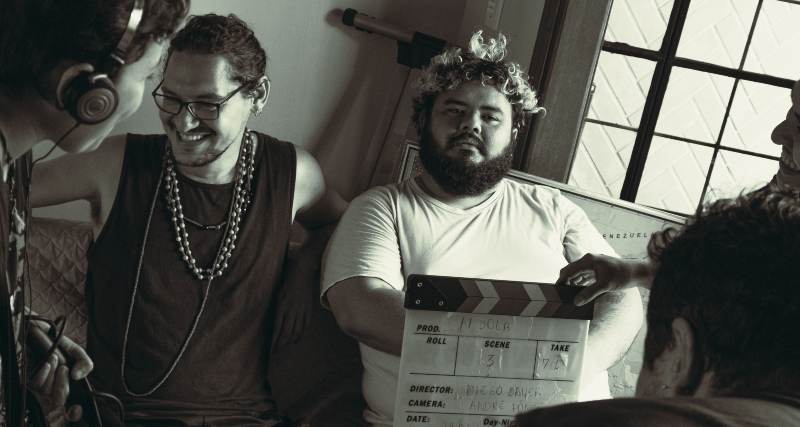
“The reactions are going to be divided, right?” Diego Bauer, director of acclaimed Amazonian short films in recent years such as Enterrado no Quintal and Terra Nova, does not hide the uncertainties surrounding the reception of his new film. Set to open the Olhar do Norte Festival at the Teatro Amazonas on the night of December 24, Ri, Bola blends bromance, Marginal Cinema with Cinema Novo, fiction and documentary, along with plenty of experimentation based on an inside joke.
The starting point is the disappearance of the peculiar laugh of Felipe Maya Jatobá, known as Bola. An actor and general director of the Amazonian theater group Jurubebas, he became a familiar figure on Instagram thanks to César Nogueira, the cinematographer and co-founder of Artrupe, Bauer’s production company. The reason? His pre-dated, uncontrollable laugh, capable of making Silvio Santos’ colleague jealous. However, a family tragedy and the resulting trauma caused the laugh to disappear.
Encouraged by César and Bola, Bauer made the search for the lost laugh the central theme of his new short film. “From the beginning, the idea was to be the opposite of Terra Nova, meaning the least classic, least formal, least narrative I could make. My idea was to really blur the line between what is real and what isn’t,” Bauer said in an interview with Cine Set.
A LITTLE BIT OF GLAUBER, A LITTLE BIT OF ‘WHITE CHICKS’
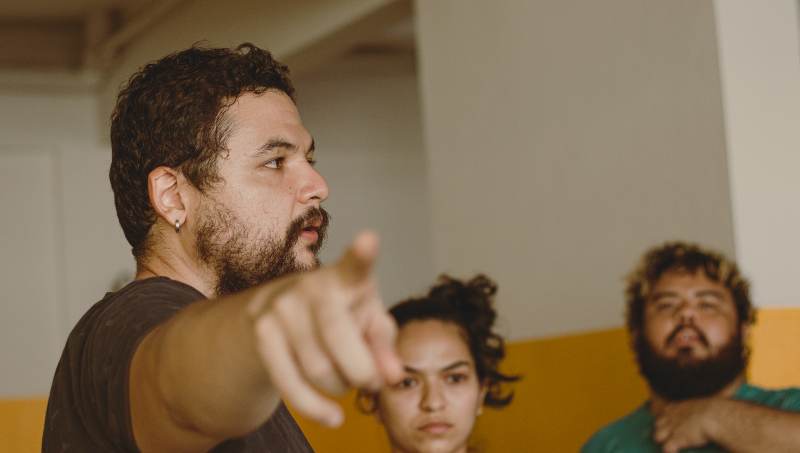
The short, filmed in 2022 in guerrilla style—meaning on a zero-budget—follows Bola alongside his loyal sidekick César. At times, they’re giving an interview complaining about the “cancel culture” of the new generation; at others, they’re waiting for a bus with random companions or hunting for a lost key under a car, eventually being surrounded by friends from the theater scene for a final ritual.
And there is no shame in defining this friendship as something akin to middle school. “The kind of comedy that could make Bola laugh was something more vulgar,” the director admitted. No wonder, then, that excerpts from classic slapstick comedies like Scary Movie and White Chicks are shown.
“I think one of my main characteristics as a person is sarcasm, irony, and self-deprecating humor. However, even though I am a fan of comedy as a viewer, I’ve always put comedy on a pedestal. It’s very difficult to produce comedy because, beyond dedication and hard work, it requires something very natural from the person,” Bauer said.
However, Bauer reveals that his influence comes from decades ago, rooted in his cinephilia. “For me, Ri, Bola is a shameless copy of Di Cavalcanti (1977), by Glauber Rocha, of Marginal Cinema, and the concepts of Rogério Sgarzela, especially O Signo do Caos (2005). They are feverish, strange works, but ones where things escalate until you get to a point that knocks the viewer off balance.”
SOUND AND VISUAL EXPERIMENTATION
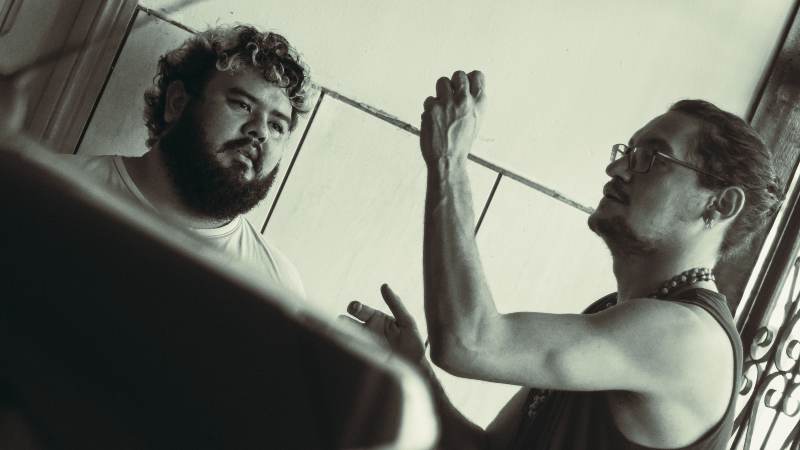
Diego Bauer has also directed the short films O Tempo Passa, Enterrado no Quintal, Obeso Mórbido, and Terra Nova.
Following the line of experimentation, Bauer uses the unusual starting point and an out-of-place journey to experiment with a variety of visual—Ri, Bola adopts, for example, a 4:3 aspect ratio and black-and-white photography—and, especially, auditory possibilities. “My main goal in the film was to do a sound investigation, since we’re talking about laughter. A person’s characteristic is their laugh, the organic, natural sound they make. So, I wanted to explore what laughter says about us,” Bauer explained.
For the script, two long interviews with Bola and César served as the basis for the situations in the film, some more directed than others. While some scenes stick to the original script—like the strange bus stop monologue, for instance—other sequences, such as the conversations, are more fluid. The stitching and transformation into a unified piece, however, Bauer credits to a key partner. “The real screenwriter is Eduardo Resing, our editor. He’s a genius and responsible for the sonic overdose I was aiming for.”
All the risks lead to uncertainties about the film’s reception, not only at the Olhar do Norte but also at Cine BH – Belo Horizonte International Film Festival and the Olhar Film Festival – the Itinerant Amazonian Film Festival. “I believe the story of friendship is universal. Everyone has that friend with a different laugh, so losing that becomes a kind of fantastic element. It’s kind of Woody Allen, you know? In any case, I’m extremely proud of Ri, Bola. It had the potential to be a huge embarrassment, but once we found our way through it during production, I think it worked,” he concluded.
CREDITS
Writer, Director, Producer: Diego Bauer
Cast: Felipe Maya Jatobá, César Nogueira, Wermon Stattos, Isabela Catão, Daniel Ferrat, Robson Ney, Andreza Afroamazônica
Producers: Karol Medeiros and Italo Bruce
Cinematography: André Cunha
Editing: Eduardo Resing
Sound Recording: Taiara Guedes
Sound Editing and Mixing: Lucas Coelho
Color: João Gabriel Riveres