

Forty years later, the city of Detroit remains grim, and star Eddie Murphy remains very funny… and lazy. This latest installment, “Beverly Hills Cop: Axel F,” a new sequel to the 1984 hit that turned Murphy into a global megastar, arrives on Netflix as a nostalgia exercise that provides some amusement but also never ventures beyond its comfort zone. And it doesn’t even try. It’s nice to see the hero Axel Foley and his associated characters and colleagues again, but by the end of this fourth film, you’ll wish they had been given something better to do during those two hours.
In the story, Foley, the slick-talking Detroit cop played by Murphy, gets entangled in a new mess when his lawyer daughter starts receiving threats. This prompts him to return to Beverly Hills—for the fourth time—to assist her, leading to another explosive police case. And that’s about it. It’s the standard plot of any Beverly Hills Cop sequel, with a few good action scenes and the occasional inspired joke.
Modernized Remix

Directed by Mark Molloy—making his cinematic debut after working on commercials and TV series—the film doesn’t hide from the start that it’s based on nostalgia: the first action sequence shows Foley and a potential partner wreaking havoc in Detroit in a truck, set to the same music as the opening sequence of the original Beverly Hills Cop. The only difference is that Murphy is now driving, whereas in the original, he rode in the truck bed. This is what “Beverly Hills Cop: Axel F” is: a slightly modernized remix of something we’ve seen before.
And like a sitcom, everyone from the old films who wanted to participate has returned: Judge Reinhold, Bronson Pinchot, Paul Reiser, and even veteran John Ashton have come out of retirement to revive the grumpy Taggart. It’s great to see them again, and the old chemistry is still there—indeed, the best joke in the film involves a scene between Murphy and Reiser, revolving around the former’s age, which doesn’t seem much different now than it did 40 years ago. Well, okay, maybe 30 years ago, in Axel Foley’s last appearance in the weak “Beverly Hills Cop 3” (1994), which is even mocked in this new film.
Highlight on Action
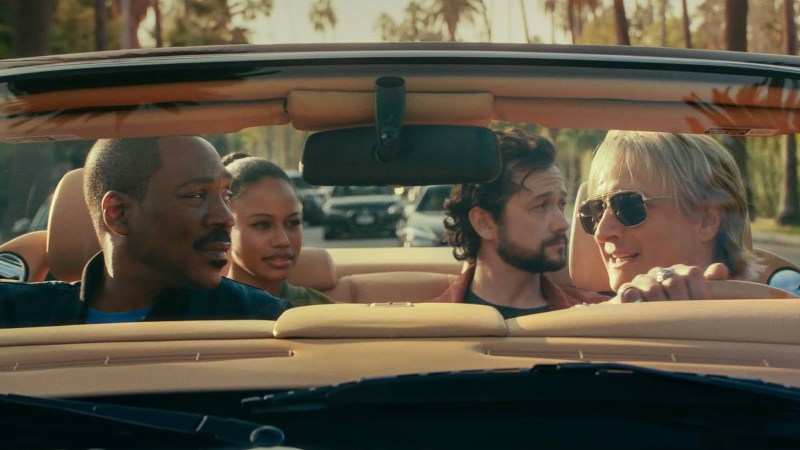
This fourth film shines most in its action scenes—it’s better when the characters are shooting or destroying things than in the comedic parts. Molloy and his team orchestrate some good shootouts and a helicopter scene, relying mostly on practical effects. The director even brings back some of the profanity and excessive violence of 1980s films: in this “Beverly Hills Cop,” there’s foul language and a bit of blood and headshots, much like there used to be more frequently 40 years ago.
And the glue that holds it all together is Eddie Murphy himself, who dusts off the old jacket and slips back into his character effortlessly. Playing Foley is comfortable for the star, who continues to make audiences laugh with just a smile or the way he delivers a line. That’s why it’s a shame the lazy script doesn’t take more incisive advantage of the protagonist’s presence in a Beverly Hills that’s even more snobbish and plastic than it was 40 years ago, and now politically correct. In the original film, Foley stood out in that world like an alien—a black man somewhat shabbily dressed in that chic, wealthy, white world—and the film mined much humor and tension from that context. Not so here, and this fourth film limits itself to making a joke about the size of current police cars in California.
Instead, the script prefers to invest in a father-daughter conflict—portrayed by Taylour Paige—that is entirely clichéd, and in a few scenes between Foley and the detective played by Joseph Gordon-Levitt. Oh, and this time around, the villain is played by another 1980s legend, Kevin Bacon, in a role where it’s clear from his first scene that he’s the bad guy.
Middle Ground
Between pros and cons, “Beverly Hills Cop: Axel F” ends up in the middle ground: given the overall quality of Netflix releases, this one is decent, but for those expecting something different because of the brand and Eddie Murphy’s presence, it’s best to temper expectations. In fact, none of the Beverly Hills Cop sequels are all that great: this fourth one, at least, is easily better than the third. But that electricity of the original, capturing one of the cinema’s greatest comedy geniuses at his peak, in a state of grace, that has never been replicated.
Still, this new film could have recaptured a little bit of that spark if it wanted to. However, those involved in its making didn’t seem to want to. It happens when easy nostalgia dominates actors, filmmakers, streaming platforms, and even some viewers.