
George Miller’s career is quite curious: the Australian was a doctor before moving to cinema, making short films in the nascent film industry of his country, and 45 years ago, he released Mad Max (1979), a low-budget action and revenge film marking his debut in feature films. The production became a global success, catapulted a young man named Mel Gibson to fame, and over time defined an entire aesthetic and subgenre of cinema, the post-apocalyptic action film, which inspired hundreds of other films and works in different media in the following decades.
Then Miller became a student of mythology. Virtually all his subsequent films – and there haven’t been many in 45 years of career – have depicted characters on journeys, heroes involved in quests to improve their worlds or, at least, their lives, while also influencing others. These themes, in one way or another, appear in “Lorenzo’s Oil” (1992), “Babe” (1995), “Happy Feet” (2006), and “Three Thousand Years of Longing” (2022). Sometimes, he even drew inspiration from ancient religions and myths to compose his stories.
This mythological trend began with the masterpiece “Mad Max 2: The Road Warrior” (1981), the first return to the post-apocalyptic universe, creating one of the most kinetic films of all time and transforming the vengeful cop from the first film into a hero wandering the devastated land, becoming a myth in his own way. In recent years, when he resurrected the saga in “Mad Max: Fury Road” (2015), Miller maintained this characteristic, now adding another mythological figure, the heroine Furiosa – the film had Max in the title, but the protagonist was indeed the character played by Charlize Theron. Moreover, Miller made what, in my opinion, is the best action film in the history of cinema.
Now, in “Furiosa: A Mad Max Saga,” Miller wants to build the myth of Furiosa from its foundations. The film is a prequel, set before “Fury Road,” which in itself brings a set of challenges to the filmmaker and his team and actors. But Miller shows ambition: we see young Furiosa (Alyla Browne) being taken from her home, an oasis of life still untouched by the desert. She ends up under the yoke of Dementus (Chris Hemsworth), a bandit of the devastated land who gradually grows in importance. Later, her path crosses with Immortan Joe (Lachy Hulme), another desert tyrant who commands the Citadel. She grows up, but the adult Furiosa (Anya Taylor-Joy) never forgets her desire for revenge against Dementus.
EXPANDING THE UNIVERSE
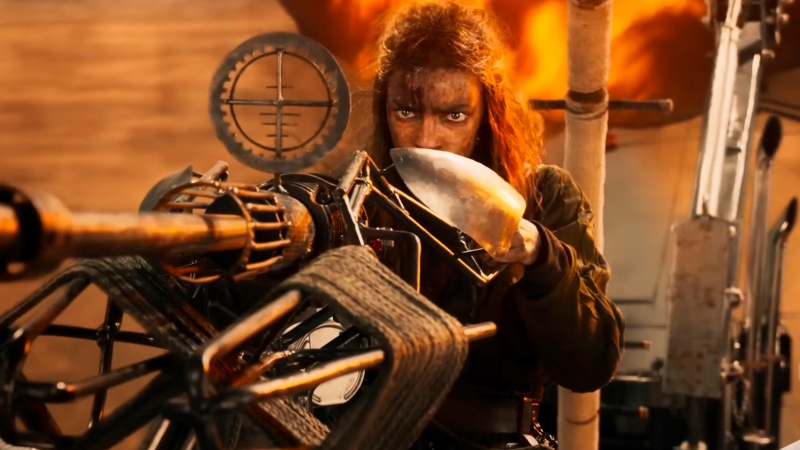
The greatest quality of “Furiosa” is the opportunity to explore a bit more of the desert and the various settings and ecosystems that formed after the end of the world: besides the Citadel, we see the Green Place, Gas Town, and the Bullet Farm, which were only mentioned in “Fury Road.” These environments, each with its own functioning and visual style, expand the scope of the always fascinating universe conceived by Miller and production designer Colin Gibson.
And, of course, the vehicles cannot be overlooked, as impressive as always: from Dementus’s three-motorcycle chariot to the first version of the War Rig, the cars and trucks – and even some aerial vehicles – become characters that help tell the story.
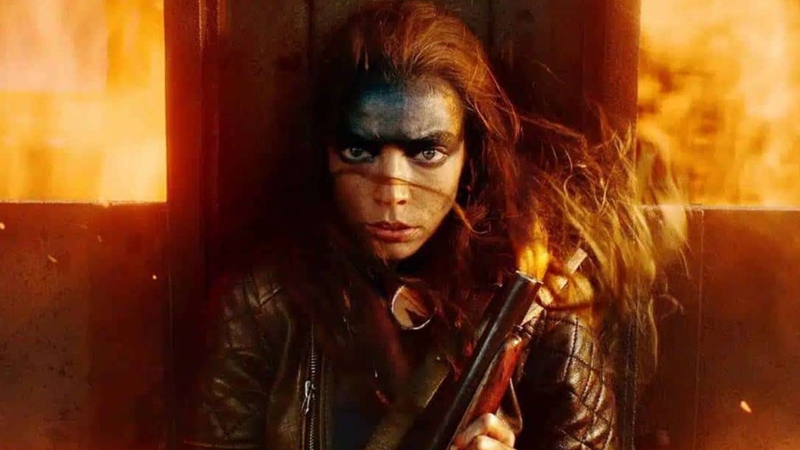
Amid these settings, we follow an epic story, narrated and divided into chapters, to emphasize the legendary nature of what we see. The two fundamental elements in the story are the performances of Taylor-Joy and Hemsworth, who do not disappoint – she embraces the responsibility of succeeding Charlize Theron with courage and commitment, acting with her expressive eyes and face, as Furiosa speaks very little in the film; he creates a character initially jovial and seemingly sympathetic, but whose cruelty appears at key moments in the film, and the actor manages these transitions well.
ONE STEP BELOW
However, “Furiosa” has two unavoidable problems that prevent it from surpassing “Fury Road.” First, the aesthetics are generally very derivative of the 2015 film – even the opening credits with narration are identical. This makes “Furiosa” lack much of a “wow factor”: there are great moments, but it doesn’t evoke the awe that some images and elements of the other film did.
Paradoxically, the director’s ambition also becomes a problem: no one should blame Miller for being ambitious, but sometimes this ambition and grandeur lead him to rely heavily on computer graphics, and in the Mad Max films, rawness always worked better, the vision of real car crashes and action is part of the experience. “Fury Road” also had its digital tricks, but most of the time, they served to enhance what had already been filmed in front of the cameras. As impressive and incredible as some moments of “Furiosa” are, there are many that are done digitally, which diminishes the sense of spectacle.
Even so, these problems do not greatly detract from the film, which remains another incredible visit to a very peculiar and personal universe that has fascinated audiences and other filmmakers for many decades. At least George Miller is honest: “Furiosa” seems to have been made as a complement to “Mad Max: Fury Road.” It works on its own but also pays tribute to the remarkable previous film, even including some of its legendary scenes in its final credits.
What matters to him is to fix in the viewer’s mind another myth, another heroine who went in search of revenge, never managing to return home – and the climax of this film even evokes memories of the final minutes of the original “Mad Max,” making the saga come full circle. But in the process, the journey becomes another legend, not only of the post-apocalyptic desert but of cinema.