
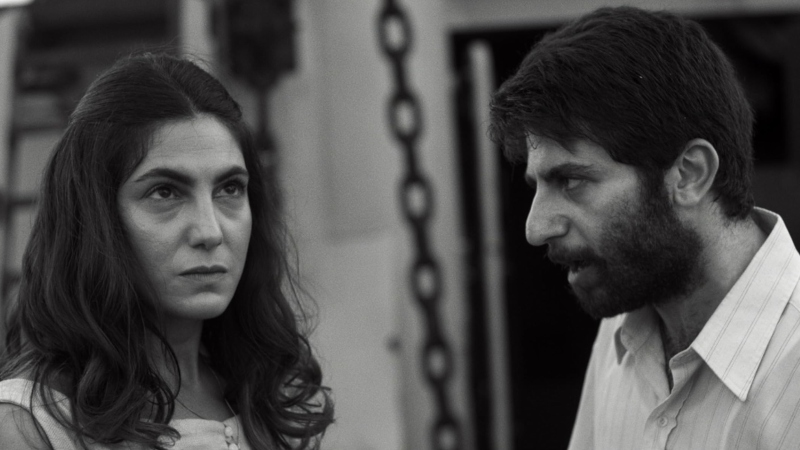
The black and white of Pierre de Kerchove’s exuberant photography is undoubtedly the standout element in Marcelo Gomes’ adaptation of Milton Hatoum’s book, “Relato de um certo oriente.” Here, one word is exchanged for another, becoming a portrait, which makes all the difference when you think that the film distances itself from what the characters think about their situation and ends up capturing their image in a more symbolic way.
It’s all very beautiful. Very expressive. It stands out in a context of Brazilian cinema that often worries so much about its discourses and themes that it “forgets” to articulate this through sound and image.
Not that politics and important subtext don’t exist and aren’t clear here. But what communicates the most is the use of light, shadow, focus, depth. The use of sound. The editing.
In the opening scene of “Portrait of a Certain Orient,” better said, in the frame, a gigantic Amazonian tree is captured with a wide-angle lens that distorts the surrounding scenery, transforming that world into a magical one. This is soon replaced by the contrasting emptiness of the Lebanese landscape, where we meet the two siblings who lead this story. Although heavy, tragic, and seeking to represent the experience of refuge and immigration, it behaves like a very simple tale.
From there on, the scenery often steals the scene from the drama. The composition. The use of layers of depth of focus, always placing these people in relation to the world that changes around them. The different boats. The oppressive and ever-present sea. The nocturnal forest, seductive and terrifying, with its white points in the black night and the sound of wildness in its depths.
It’s impossible not to remember, from this visuality, other films by the filmmaker. From Verônica sinking in the Recife buildings in “Once Upon a Time I Was Verônica,” to, especially, the unusual duo of a German and a Cearense selling aspirin in “Cinema, Aspirins, and Vultures.” But if there the image used the obtuse light of the sertão to think about the era and the emptiness of a country being built, here the ultra-contrasted chiaroscuro of the night seems to want to emphasize that this nation in formation came to exist in a very lively and inhabited place.
In a way, it’s as if “Portrait of a Certain Orient” materializes that terrifying Amazon that haunts João Miguel’s character in “Cinema, Aspirins, and Vultures.”
But there is another, slightly more uncomfortable echo from the director’s past cinema: the way the staging and melodrama almost never reach the power of the formal construction.
Here, in a film of basically five characters – two siblings, one (or two) suitors, and two (or one) friends – we never emotionally connect with the dramatic complication. Although everything is very clear regarding what happens there, everything is very understandable.
Grief. Past traumas. The weight of religious influence. Depression. The impossibility of acceptance. (another thing that converses with the existentialist protagonists of his other films)
But when it comes to making us feel, again, we think about the beauty of what we see on the screen. The symbolic image of two women (one indigenous and one Arab) playing with each other’s hair. The scene where a Muslim man prays not on a traditional rug but on a straw mat in an indigenous tribe. Someone looking deep into the eyes of the river and the river looking back. The overlapping of pajelança chanting with Catholic prayer in French already mixed with Lebanese Arabic.
Everything is so powerful allegorically and symbolically and represents so well and so much better than any speech the rhetoric of how Brazil is a country of this cultural clash, made of peoples and cultures that were already a mixture of others. Two very different men from a North African Arab country already affected and shaped by French colonization.
The cast of French, Italian, Lebanese, Palestinian, and indigenous actors works very well, even if they don’t always manage to overcome the naturalistic currents that limit them.
In the end, the white phrase on the black screen that probably comes from Hatoum’s book, “Relatos,” is what moves us emotionally the most. The idea of how the past is something that always haunts us, no matter how invisible it may be, as if it were “a wave from a transparent hand.”