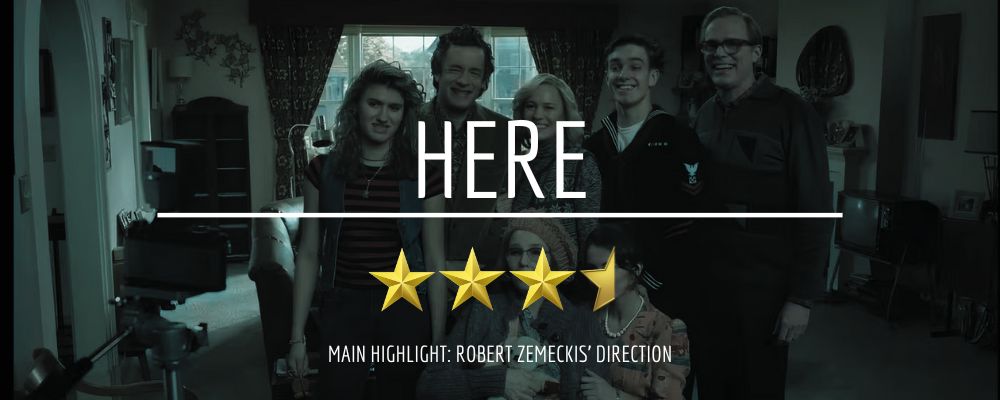
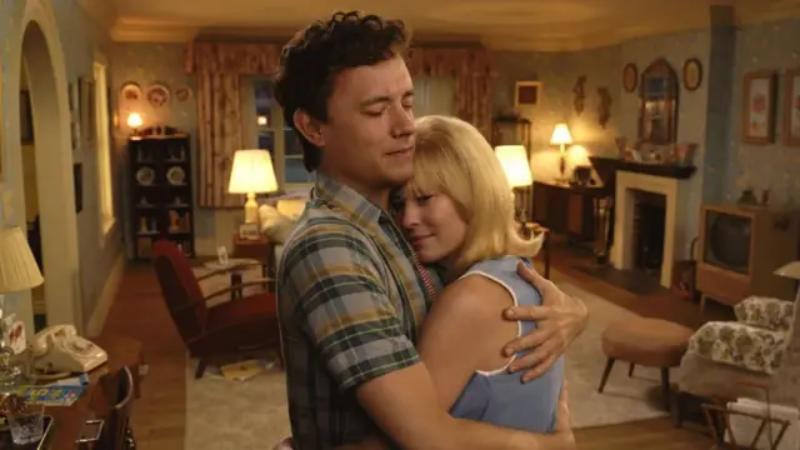
The most striking moment of Here happens in the first half: Richard is sitting in his armchair at home after a regular day at work when a tiny figure, dressed as a ghost, invades the room with short steps. Slowly, it approaches him and gives him a “scare.” At first, Richard doesn’t understand, but quickly starts shouting “ghost,” “ghost,” as his daughter chases him, accompanied by laughter from his wife, Margaret.
A silly thing, right? However, here lies Robert Zemeckis’ great discovery in the latest film of his career. Reuniting with the team from Forrest Gump — screenwriter Eric Roth and actors Tom Hanks and Robin Wright — the director/screenwriter seeks to create a counterpoint to the 1995 Oscar winner. While in Forrest Gump the extraordinary was found in the protagonist’s relationship with some of the greatest events of the 20th century, Here focuses on the beauty of the simple act of living: the joys, the sorrows, the frustrations, the good and bad surprises, the plans realized and failed.
And anyone who thinks Zemeckis adopts a romantic or idealized view of life is mistaken. Here does indeed capture the good moments when harmony reigns and everything seems destined for success and happiness — the night of love, the wedding and Halloween party, a celebratory dance, the “scare” mentioned in the first paragraph — but it also takes an interesting look at the sacrifices made over time and their consequences.
Of dreams set aside, sometimes by pragmatism, sometimes by complacency, sometimes by the terrible fear of uncertainty. Of the exhaustion from the same routine and never taking the desired step. Of regrets about how certain actions could have been different, of vices one can’t break free from, of not valuing what was important at the exact moment. Of time flying by.
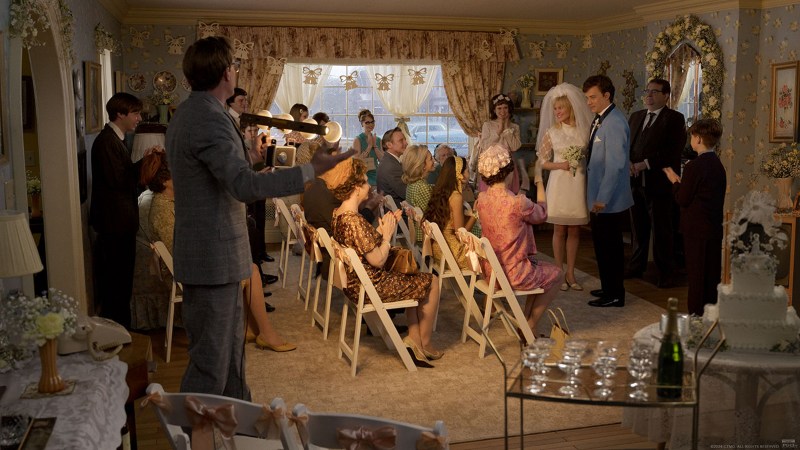
The ambitious narrative of Richard McGuire’s graphic novel of the same name, however, works only in parts in the adaptation. Since the focus is on Hanks and Wright’s family, all other characters seem to have their dramas only briefly touched upon, alternating between good and bad moments. While the windows that open, almost like computer tabs, do manage to establish emotional connections and situations that never change, regardless of the time period, they also become tiring due to repetition in a 1h45 movie.
Zemeckis, however, is not a Richard Linklater-type director who is detached from grandeur in terms of spectacle. Right from the start, in the best style of 2001: A Space Odyssey, the director of Back to the Future, Gump, and Contact spans billions of years, moving from the age of dinosaurs, through the glacial period, and up to the emergence of indigenous peoples. All of this in just a few minutes. The epic tone is maintained in the narrative structure that weaves together stories that interlace and connect, spanning at least six or seven centuries.
With the camera positioned in a single spot throughout (almost) the entire film, Here becomes a visual delight through the transformations of spaces over time, whether in the change of flooring, technological devices, or the furniture and paintings in the house, reflecting its inhabitants and the trends of each era. The CGI, which can rejuvenate Hanks and Wright almost perfectly, contributes to the fable-like tone, at times excessive, that is so characteristic of Zemeckis.
This melancholic yet hopeful gaze on life makes Here escape — thankfully — from the coachy, simplistic, and manichean discourses that reduce the complexity of human existence. A perspective that only someone with 72 years of life, with a career marked by the alliance between the past (theme) and the future (technology), can offer when addressing universal questions.