Here’s the setup: Josh Hartnett, the dad of the year, is at a pop star show with his little girl. The pop idol in the scene is played by Saleka Shyamalan, who, in real life, also has a career as a singer. The more observant reader might have noticed that Saleka is the daughter of the director of this “Trap,” M. Night Shyamalan. In other words: we have a Shyamalan making a film entirely in “dad mode.”
This is quite natural, given that family unity is one of the central themes in the work of the Indian-American filmmaker. The novelty comes in the central question behind this plot: what if your father were actually a serial killer?
This is the case for poor Riley (Ariel Donoghue), who has no idea that her father, Cooper (Hartnett), is the feared murderer known as “The Butcher.” And this secret risks coming to light when Cooper discovers that the show he’s attended with his daughter is, in fact, a complex police operation aimed at catching him, or rather, The Butcher. How to escape?
Right away, we see two twists: our protagonist is a brutal murderer and, worse, the family unit is being corrupted from within by this disguised monster. But there’s a third twist at play: “Trap” is directed by Shyamalan with a turn towards macabre comedy.
It feels like this is Shyamalan’s “Frenzy.” I’m referring to Alfred Hitchcock’s late 1972 film, also about a murderer and also morbidly comedic. The pleasure here lies in trying to guess how our protagonist will get out of this one, what new plan he will devise, what new cruelties he will commit.
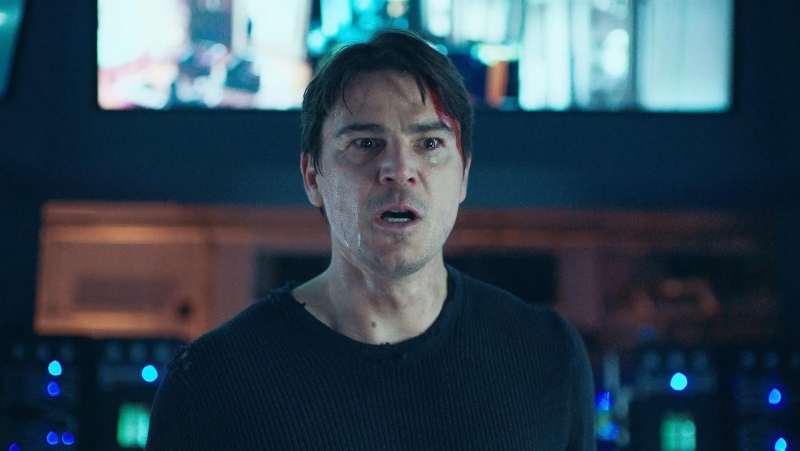
Hartnett is crucial in this regard. Much of the humor in the first half of the film comes from his trapped-animal gaze that refuses to falter, from the way an arched eyebrow suggests all his cynicism and sense of superiority. Watching his dissimulation becomes a source of amusement for the audience. When we laugh, we’re already in his pocket.
Indeed, we don’t have the dramatic weight of a “Knock at the Cabin,” his last film. And yet, “Trap” is deeply devastating. When we realize that we are rooting for the villain, it’s already too late: Shyamalan has twisted the knife.
And he goes deep. Throughout the film, we see Hartnett causing grotesque injuries to people unrelated to the situation, just to escape. We also learn about his cruel modus operandi with his victims: dismemberment. More importantly, we gradually come to the inevitable realization that, no matter how this story ends, poor Riley is going to come out shattered, one way or another.
Thus, perversion in the sense of being an inversion of one of the filmmaker’s motifs. The threat to the family is inescapable because it comes from within the family unit itself. It’s a profoundly tragic setup. That Shyamalan can elicit laughs from such pain is a testament to his talent. And that a film like this, highly original and undeniably personal, can fill its opening night in a multiplex in Tijuca might be proof that he is the greatest American filmmaker working today.